Monday, 17 November 2014

Design gallery----David Zwirner

David Zwirner

(The David Zwirner 20th New York Gallery )


  • The new gallery facade is board-formed-concrete(material), and with rows of teak-framed windows set just a few inches,could let the sun light through in, this building give people a feeling of in nature. The wall color is stained wood(teak wood) and quite environment protecting.
  • Teak, which is also used for the window frames on upper floors, creates a warm contrast to the texture and cool tones of the concrete.


  • This is an image of the  different layers.

  • This is an image of ground floor.


  • This is an image of third floor.


  • This is entrance of gallery. On the ground floor, a sliding teak storefront system allows the base of the building to open for art access.

  • On the ground floor, the main exhibition space is an expansive gallery with high ceiling. Concrete floors bring an industrial sensibility to the space, along with four north-facing  sky lights.
  • Windows help connect a variety of spaces, including an intimate second-floor gallery.


  • The walls surrounding the building’s stair are made of the same board-formed concrete of the facade. The depth of each concrete steps is only 3 inches, very thin.


  • Public exhibition space continues on the second floor with a very different environment: a 2,000 sf space with 14' ceilings and white oak floors. Unlike the sky lit ground floor, second floor galleries are lit naturally from the side by a series of large windows.
  • Levels three, four, and five contain the gallery's private functions such as viewing rooms, offices, a library, and art handling areas.
          ( Reference from http://archpaper.com/news/articles.asp?id=6537#.VGnyefmsV0o)


  • The 4,400-square-foot main gallery captures daylight with four north-facing light monitors.
         (Reference from http://archpaper.com/news/articles.asp?id=6537#.VGnyefmsV0o)


  • The building is specifically designed to accommodate large installations and exhibitions of works by estate artists.Inside, gallery and showroom spaces are diverse in their scale, materiality, and lighting,offering a flexible range of environments for the display of art.

  • ( Reference from http://europaconcorsi.com/projects/252563-Selldorf-Architects-David-Zwirner-20th-Street/print)

    (All of images resource from: http://www.selldorf.com/projects/featured/david-zwirner-20th-street/)


    Saturday, 15 November 2014

    Design gallery----white cube

    WHITE CUBE ART GALLERY


  • White cube's new building in Bermondsey and designed by Casper Mueller Kneer Architects. This building structure is modern simplicity.


    • This is a contemporary art gallery and quite complex which existing extend 1970 warehouse. More than 5440 m2 of existing warehouse space were transformed to provide several exhibition spaces each with their own character
    • For example, a suite of private viewing rooms, an auditorium, a bookshop, an offices as well as facilities for art storage.
    • Before this building is industrial character and enhanced by new additions and modifications now.

    •  This is an image of ceiling.

    •  This is an image of ground floor.
    •  This is an image of first floor.


    • This is an image of analysis floor
    • There are three principle exhibition areas like: The‘South Galleries’provide 780m2 of column free space and act as the main display area. The‘North Galleries’are smaller,more experimental in character.‘9x9x9’is a centrally located cubic space of shape–the only space penetrating the existing building envelope and flooded with natural light. And it for the established artists. An auditorium allows the presentation of films and lectures.


    • This is an image of entrance.(This entrance is too long and the light could guide you go somewhere, give you the right direction at this gallery.)


    • The entrance to the gallery is quite dramatic with the very wide corridor right behind the glass door, top lit by a row of neon lights which are reflected on the polished floor. 
    • The combination of perspective and the use of lights and building materials give this space an almost silence theatrical effect.
    • The north galleries on the right for emerging artists and on the left the south galleries and the 9x9x9 room.
    • The exhibition space is divided by the corridor in two main units.


    • The lighting design provides a completely even light.(artificial light) Some galleries combine natural and artificial light. All viewing rooms and gallery ceilings allow for varying sub divisions by temporary walls(the walls could move and according them change).
          (All of images resource from: 1. http://www.e-architect.co.uk/london/white-cube-gallery
          2. http://cmk-architects.com/projects/white-cube-bermondsey/
          3. https://architectureas.wordpress.com/tag/white-cube-gallery/)


    Wednesday, 12 November 2014

    Design gallery----Leventis (favorite)

    Leventis Art Gallery and Apartments

    (This is one of the galleries I focused on my research,because the project 2 that we need design a gallery.)


            (Resource: http://fcbstudios.com/work/view/leventis-art-gallery?sort=highlights)                                        
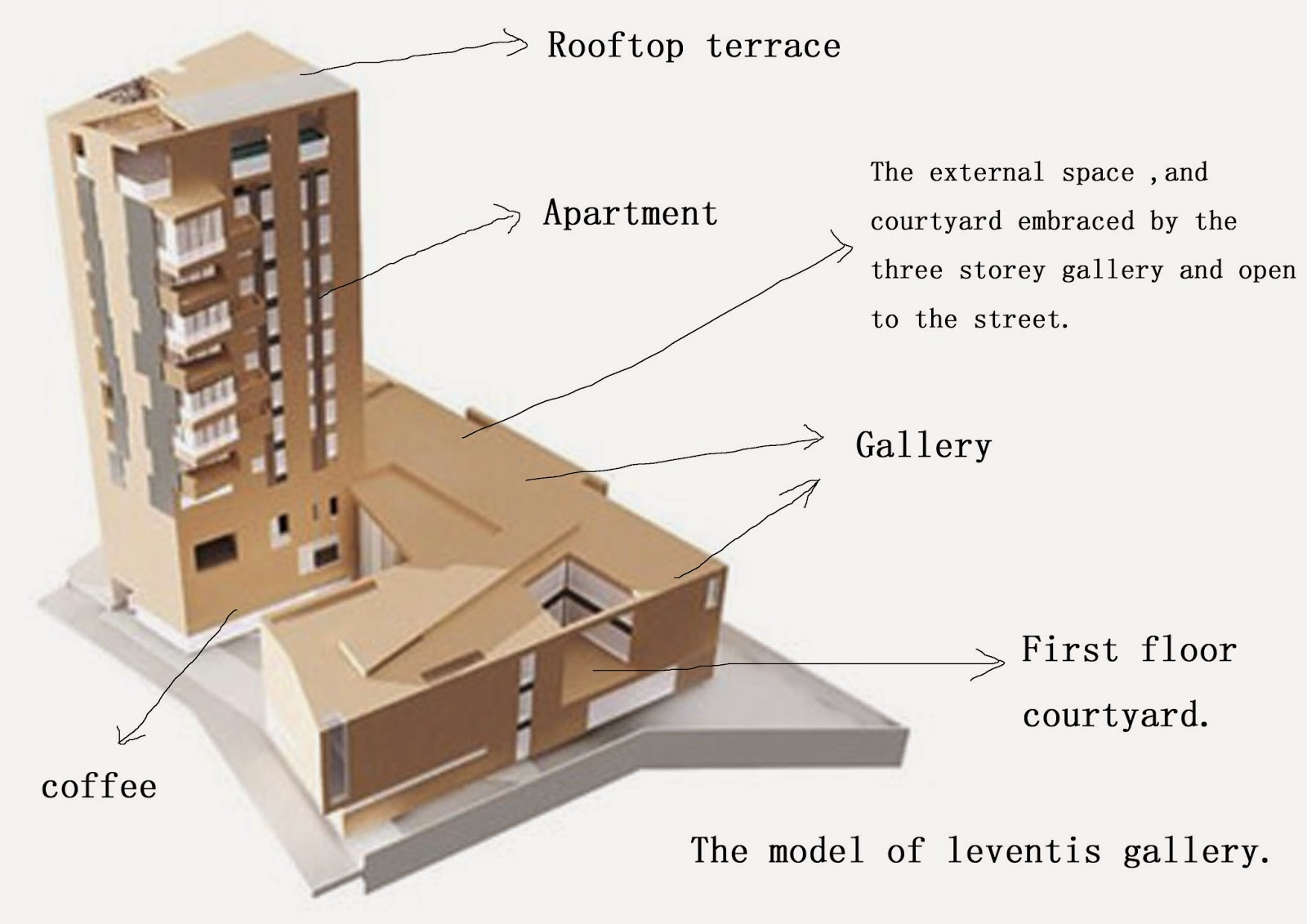
    • A new art gallery with restaurant and apartments for the AG Leventis Foundation, a private foundation supporting educational, cultural and philanthropic causes which promotes Hellenic culture. Location in Nicosia, Cyprus.

    • The function of outside


    • The different side of building


    (Resource: http://www.resde-dpm.com/selection-of-resde-projects/ag-leventis-art-gallery)


    • This is ground floor

    • This is first floor


    • This is second floor


    • Half of the building is used for residential purposes.(Apartment)
         (Resource: http://fcbstudios.com/work/view/leventis-art-gallery?sort=highlights)


    • This is in the middle of apartments and the gallery space.
    • Cyprus has a Subtropical climate - Mediterranean.
    • Leventis Art Gallery made of local stone with small, shuttered openings which excluded the fierce heat in summer but open to allow the winter sun to penetrate.

    • This is ground floor-----Entrance


    • The inside of leventis gallery.


    • The staircase, effectively a substantial metal and wood sculpture, is a dominant and visually satisfying feature.


    • Daylight from roof lights developed to exclude hazardous UV, floods the galleries.

         
    • Installation view,A.G LEVENTIS GALLERY.


    • Echoing the traditional use of slatted timber shutters, openings and balconies are screened with perforate metal panels, the bespoke patterning of which was inspired by William Morris's olive leaf design. The bronze anodised aluminium (also used for curtain walling and glazing) is rendered almost the same color as the stone in bright light, and as shutters are moved to admit or exclude sun the apparent solidity is transformed.


  • The galleries, which are all located on the first floor, have ceilings made of translucent glass. Visitors would become immersed in the collection in these calm and top lit spaces, and reoriented by occasional views into the courtyard.


    • The Leventis Gallery and apartments are designed to minimise energy use by avoiding potentially harmful solar gains, enhanced insulation and air tightness and use of day lighting wherever feasible, but will still require cooling through the summer months


    • The author points out that apartment makes the development visible across the city and creates an identifiable icon for the gallery.
                 (Resource:  http://fcbstudios.com/work/view/leventis-art-gallery)


    Saturday, 8 November 2014

    Tasks---Interviews and Questionnaires

      How are interviews and questionnaires  used in research?

       1. what is interview?

    • An interview is a conversation between two or more people where questions are asked by the interviewer to elicit facts or statements from the interviewee. Interviews are a standard part of journalism and medium reporting, but are also employed in many other situations, including  qualitative research. (Resource from Wikipedia)
    • Interviews with a specific purpose and a set of scientific design, preparation and implementation of the principle .
        2. what is questionnaires?
    • A questionnaire is a research instrument consisting of a series of questions and other prompts for the purpose of gathering information from respondents. (Resource from Wikipedia)
       3. How are interviews and questionnaires used in research?
    • The first question is whom should we interview and questionnaires? As in all surveys, using either questionnaire or interview as the means of data collection, we should attempt to involve as many participants as possible. And interviews and questionnaires are a time-intensive research instrument, so we must chosen for particular interest which is according to our research purpose and theme. (For example, we would like evaluate some school equipment, we could find people who are students or staffs. And people who usually use or attention to the school equipment and so on.) 
    • The second one is how will we get access?  In advance of thinking your study to allow potential participants time to consider whether or not they wish to be involved. Thinking about some situation will happen, for example people may refuse or reluctantly interviews, write questionnaires or online questionnaires. The places, times and persons are important elements.
    • And What questions should we ask?  Every interview and questionnaires must have a purpose, it must draw from some underlying expectations about what is the important information you are seeking.
    • How should I phrase we questions?  On the one hand you will want to avoid bias, to be careful not to ask questions in such a way that you lead respondents into providing confirmation of your own views rather than eliciting theirs. At least some of your questions should be designed so as to promote thought and give more choices.
    • What techniques should we use to get the best quality answers?    For interviews, there are a number of techniques researchers use in the natural course of the conversation to aid clarity, depth and validity. And the researcher engages in 'active' listening, which shows the interviewee that close attention is being paid to what they say, and also tries to keep the interviewee focused on the subject.      For questionnaires, these are used when you want to measure something that is latent (not directly observable, e.g. to measure an attitude.) You scale the answers like this. When designing a questionnaire you will typically utilize closed questions rather than open ones. With open questions they can respond how they want by writing their answer in the space provided.
    • How do we decide on what form of interview to use? To develop empathy with interviewees and win their confidence,and in order not to impose one's own influence on the interviewee.
         (Sources from: http://www.edu.plymouth.ac.uk/resined/interviews/inthome.htm)


       4. What kinds of data/information can be gathered using these techniques?
    •  For questionnaires, we would assign each questionnaire a number too, and then add the data from each questionnaire in number form to a programme such as Excel, SPSS or Access, thus giving you the chance to generate charts and graphs to better illustrate your answers.  For interviews, you may be able to give the data collected in one more particularly significant interview in your appendices so that the reader has a chance of checking your interpretations and selections against their source. 
          (source from : http://www2.open.ac.uk/students/skillsforstudy/using-a-questionnaire.php)


       5.Questionnaires and interviews as primary and secondary research data
    • There are a range of resources available for secondary research: the most well-known are: published statistics: census, housing and social security data, published texts: theoretical work, secondary analyses by ‘experts’ and reports,media: documentaries for example, as a source of information,personal documents: diaries and so on.
    • Advantages about secondary research are:cheap and accessible - especially a University Library, often the only resource,  for example historical documents.
    • Disadvantages about secondary research are:lack of consistency of perspective, biases and inaccuracies can not be checked, the concern over whether any data can be totally separated from the context of its collection.
    • There are a range of resources available for primary research :social surveys, questionnaire surveys and interviews: informal or structured.
    • Advantages about primary research are:quick and cheap if the sample is small, computer could  quick analysis and repetition data, allows generalization to a larger population, verifiable by replication and re-questioning of interviewees/respondents.
    • Disadvantages about secondary research are:over-reliance on computed (statistical) analysis loses individual meanings and case study data, closed questions may constrain the data, respondents may interpret the questions differently, researchers can bias the data by concept definition and question framing, response rate may be low and selection non-random.
          (source from: http://www4.caes.hku.hk/acadgrammar/report/resproc/research.htm)

    Wednesday, 5 November 2014

    Tasks---Secondary Research

       What is secondary research (secondary sources)

    • Secondary research is research that is carried out with already existing data. It uses materials as books, magazines, journals, newspapers among others. Here, the researcher needs not go on the ground since all the information collected has been documented already.  
          (Resource: http://uk.ask.com/question/what-is-secondary-research)
    • Secondary research is a method of collecting data that has already been gathered by some one else. It is a technique used when performing marketing research. It is a useful method as it allows the researcher to identify a new topic rather than one that has exhaustively been researched.
         (Resource: http://uk.ask.com/question/what-is-secondary-research)
      
       How are academic research papers and market 
       reports used to inform research?

    • Academic research is an exploratory and creative people know the objective world, choose a research topic is the starting point of scientific research activities, is directly related to the direction of scientific research, goal and content, affects the ways and methods of scientific research, determines the level of scientific research achievements, value and development prospects.
    • Market research is to use the scientific method, has a purpose, collecting, sorting and analyzing the supply and demand in a planned way, all kinds of information resources, information and data. It grasps the present situation and development trend of supply and demand, to provide correct for marketing and business decisions based on information management activities. Is generally referred to as the market investigation and study, it is a person or organization according to the specific decision problem and systematic design, collect, record, sorting, analysis, and study the market all kinds of information, report the working process of the research results. Market research is essential in the process of the market forecast and management decision making.

    • Some images


       (Resource: http://www.acaresearch.com.au/australian-market-research-blog/bid/312472/Market-Research-Identifies-Tough-Times-Ahead-for-Pharmacies)
    • We need carried out with already existing data, combine other research, for example, performing marketing research,survey,find more useful and important information. 
    • And people need do some survey including market environment survey, market demand survey, competitors survey, products survey, sales survey, advertising effectiveness survey and so on. After this survey,according this survey,to used to inform research.
         (Resource:http://afg-research.com/report/dental/090579.htm)